
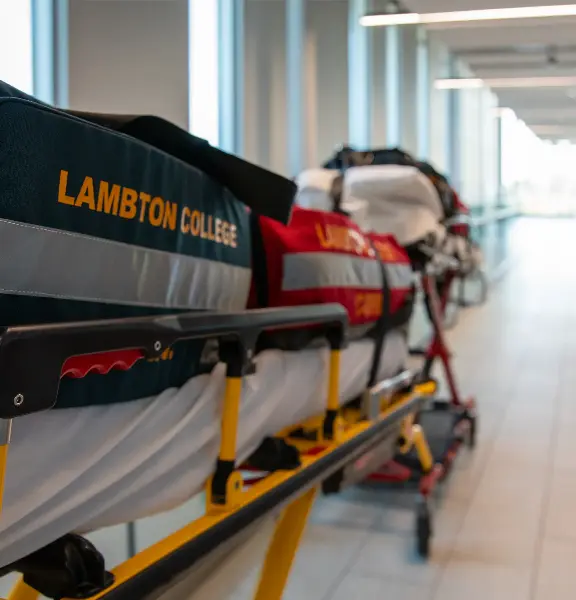
Emergency Services Fundamentals
Overview
Explore careers in emergency services while building the skills needed for future education and training.
Emergency Services Fundamentals is designed for students who are interested in public safety careers but want to explore their options before choosing a specific path. Through courses in communication, mathematics, science and technology, you'll develop foundational skills while learning about fields such as paramedicine, firefighting, policing, border services, customs and emergency communications.
The program can also help you meet admission requirements and earn credits that may apply toward related diploma and advanced diploma programs, making it a flexible starting point for further study in emergency services and public safety.
Admission Requirements
- O.S.S.D. or equivalent
Mature Student Assessment is available for this program. For more information, please contact counselling@lambtoncollege.ca. Review the Mature Student Admission process.
Academic admission requirements can be obtained through Academic Upgrading and the Pre-Programs at Lambton College.
Costs
- Year 1 $2,722.58
Please Note: These fees apply to the 2026-2027 academic year and are subject to change. Fees do not include books (unless specifically noted), supplies or living costs.
Technology Requirements
In order to keep pace with the requirements of each and every course in your program, Lambton College requires that each student have access to a laptop while studying at our college.
Courses
Introduction to Public Safety Telecommunicator
This foundational course introduces students to the structure and function of emergency services in Canada, including the hierarchy of command within police, fire, and emergency medical services. Students will explore the roles and responsibilities of sworn and civilian personnel and examine how public safety agencies collaborate to respond to emergencies. Emphasis is placed on understanding emerging technologies such as Next Generation (NG) 911 systems and mobile data communications, as well as the tools and systems that support effective coordination and response. The course prepares students to navigate the evolving landscape of public safety with a systems-based, technology-informed perspective.
Critical Thinking & Writing
This writing course challenges students to explore diverse opinions and articulate their own perspectives clearly and persuasively. Through critical reading, students will develop skills in synthesis, analysis, comparison, and response, striving for clarity and diplomatic expression of their opinions based on factual evidence. Students will practice various rhetorical strategies of persuasion and hone their writing to ensure precision and accuracy in their messages. This course lays the foundation for a subsequent research-writing course, equipping students with essential skills for academic success.
Canadian Diversity & Strategies in Community Safety
In this course, students critically identify and examine issues in diversity. Specifically, students focus on topics pertaining to inequality in various social settings, including but not limited to: race, gender, ethnicity, class and sexual orientation. Information concerning history, culture, heritage and contemporary issues relating to Canadian Indigenous groups is discussed. Incorporating social/legal explanations of diversity, students develop a clear understanding of the impacted groups and possible strategies of community empowerment.
Mathematics for Pre-Health Sciences I
By the end of this course, students will have demonstrated the ability to evaluate a variety of arithmetic and algebraic expressions and apply these principles to typical problems that arise in the health care fields. Concepts studied include numeracy fundamentals; systems of measurement and dimensional analysis; algebra, with an emphasis on analytical techniques; and geometry. Students will develop essential critical thinking and problem-solving skills through exposure to application problems, including dosage calculations and solution dilutions. Students will use numerical methods along with graphs to describe the relationship between quantities.
Psychology I
This course provides a foundational overview of psychology, exploring the biological and cognitive processes that underlie human behaviour and experience. Students are required to purchase the assigned textbook to be successful in the course.
Fitness & Lifestyle Management
This course introduces the student to concepts of wellness and provides practical strategies for developing a healthy lifestyle and physical fitness. Emphasis is placed on the student's understanding of the scope of what it means to be well, healthy and physically fit and how this relates to having a successful career in law enforcement.
Anatomy & Physiology
This course introduces the student to the human body and how it functions. The content is concentrated on cells, tissues, organs, and systems and how the systems work together for human survival. The study of the normal aging process of the systems is emphasized.
The Canadian Criminal Justice System
In this course, students acquire foundational knowledge and skills related to the development, structure and practical operation of the Canadian criminal justice system. The course is geared towards students who will become practitioners in the criminal justice field and will require knowledge of their role in relation to the justice process as a whole. Throughout the course, students will have an opportunity to critically analyze the various components of the justice system, as well as examine the overall effectiveness and efficiency of the system.
Sociology I
Focusing on the Canadian perspective SOC 1003 explores the intersectional influences on behavior within the context of human group life. The sociological perspective, data collection, socialization, crime, and the dynamics of group structure and stratification are critically assessed against the backdrop of global interdependence and socio-cultural change. Small group discussion and gamification of materials all offer an enhanced course experience for individual growth and understanding of sociology.
Behavioural Health for First Responders
The current climate in first response demands that service providers be proactively prepared with a keen awareness of the demands of the job both personally and professionally. Students who take this course will develop essential self-awareness skills, enhance their knowledge of mental health issues in themselves and others, learn to foster collegiality through team work, and augment their understanding of the impact of workplace dynamics on one's mental health. Successful completion of the course will result in improved resiliency to meet the demands of a career in first response.
Political Structure and Public Administration
Canadian politics and structure, modern bureaucracy, global citizenship, sustainability, political socialization, civil rights and mass media. Whether you realize it or not you are being influenced and your opinions are being shaped, by each and every one of these. So isn't it time to turn the tables, time to start shaping the system, in short, time to take POL 1303. By offering a survey of each of the above through the lens of intersectionality learners will explore not only the structure of Canadian politics but the influence of each sphere on public opinion, law and policy. Small group discussion and critical analysis of current events all offer learners an alternate path to demonstrate learning while expanding their understanding and employing critical analysis skills.
Fitness & Lifestyle Management II
This course is a continuation of PED 1202, further exploring concepts related to health, wellness, and physical fitness. Emphasis is placed on students identifying current lifestyle behaviours and developing strategies which would result in a healthier lifestyle. Students will also continue to work toward achieving fitness standards associated with Bona Fide Occupational Requirement evaluation.
Firefighter Emergency Patient Care
This course provides an overview of the Ontario emergency medical care system (EMS) and specific roles of members of the emergency response team. Content will cover common medical/trauma conditions, related patient care and associated situational management. Emphasis will be on the specific role and responsibilities of the firefighter emergency patient care responder and the teamwork essential to the effectiveness of the EMS response. Included will be legislation, regulations, standards and established policies, procedures and protocols as well as the role of members of the emergency response team and the specific role of the firefighter emergency care responder in accordance with current Canadian Red Cross First Responder program standards.
Contemporary Canadian Social Problems
In this course, current social science paradigms and theories will be used as a framework for analysis of contemporary social issues relevant to vocations in police services. Topics such as crime, violence, abuse, social stratification, ageism, and racism will be included. The course focus will be on how individual behaviours collectively create social issues.
General Education Elective
Communications in Public Safety
This course is designed for students in the public safety field to further develop their communication skills, which are essential for effective working relationships with individuals and teams in both the work environment and the general public. Students will write workplace correspondence and field-specific reports as well as conduct research to hone their critical thinking skills. Students will develop their oral communication skills by sharing their research with their peers through oral presentations.
Communications for Paramedics
This course tackles communications specific to paramedicine and is designed to further develop students' communication proficiency and research skills. Students will analyze and respond to paramedic scenarios to create accurate and clear paramedic written and verbal reports. Students learn medical terminology and abbreviations common to the field to improve the accuracy of their documentation. Advocacy and peer education will drive the research and documentation process. Current paramedicine issues and research will serve as the impetus for creation of informed research projects and presentations, equipping students with strategies for continued professional development.
Contact
School of Fire Science, Health & Community Services
Program Information
After Graduation
Employment Opportunities
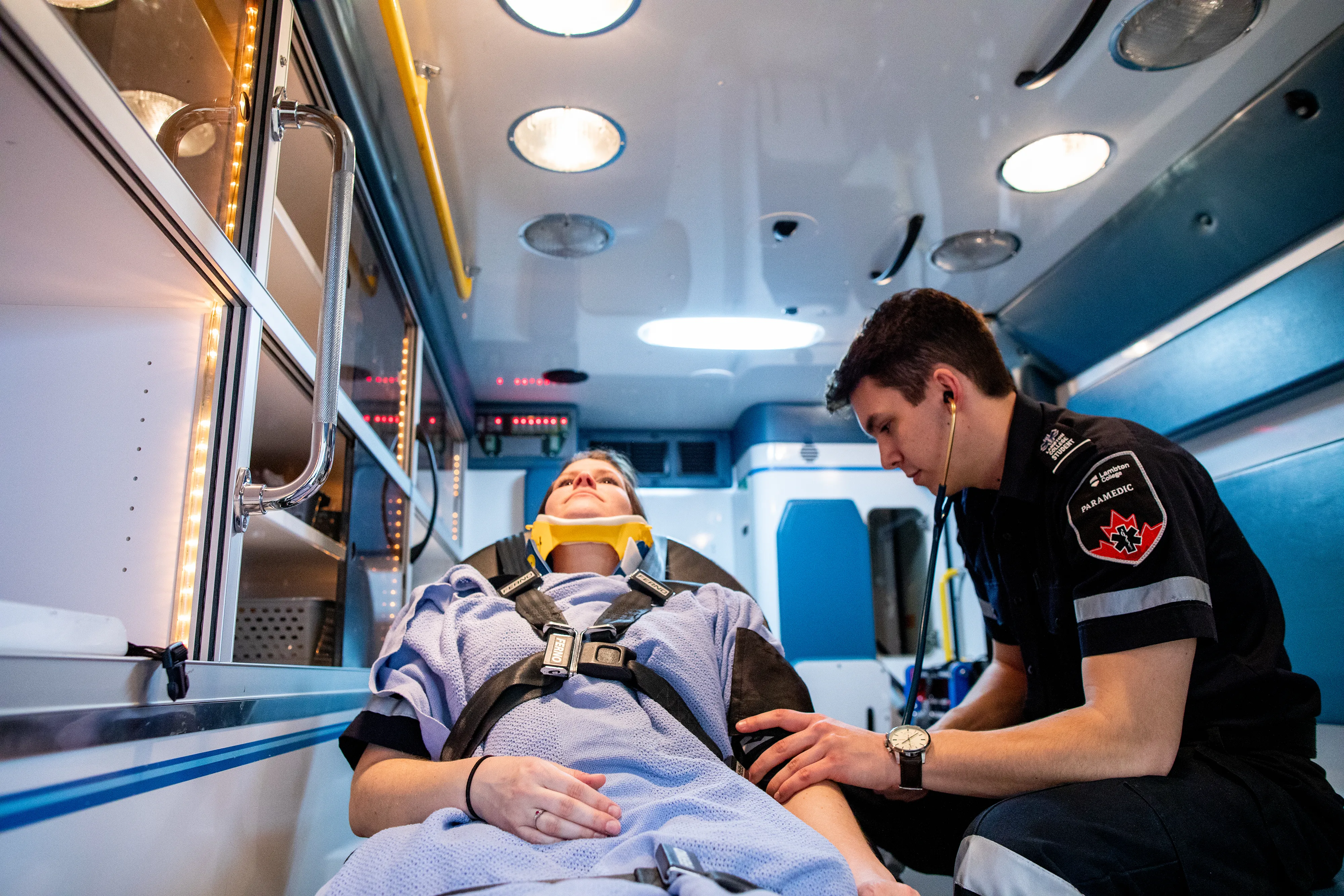
This foundational certificate is intended primarily as a pathway to further education rather than direct entry into employment. Graduates may continue into Border Services, Emergency Communications, Police Foundations, Pre-Service Firefighter Education and Training, Paramedic, or other related diploma and advanced diploma programs.
More Information
Technology Requirements
It is recommended that you use a Windows laptop for your coursework. While other devices like MacBooks or Chromebooks might work for some tasks, they may not support all the software required for your program. If you're unsure, check with your professors before buying.
Internet Speed Requirements
To get the best experience while learning online, we recommend having an internet connection with at least 40 Mbps download speed and 10 Mbps upload speed. This will help you use video calls, attend online lectures, and access other learning tools smoothly.
Because students live in many different areas, we can't suggest a specific internet provider. You'll need to check with local companies to find one that works best for you.
Laptop Requirements
In order to access the internet and virtually-delivered software and courseware, student laptops should include the following at a minimum. By meeting the following specifications, students will be equipped to access software and courseware on their laptop through the internet:
- Intel i5 8th Gen Processor or equivalent
- 8GB of RAM
- 100 GB HDD or more
- Webcam with a microphone
- Wi-Fi capable (802.11n/ac 5GHz)
- Windows 11 operating system
Mobile Device
Students will require a mobile device (smartphone) for:
- Accessing your digital student ID
- Using campus applications and services
Software
To ensure students are getting the most our of their classroom experience, some software will be required.
Lambton College has made this software easily accessible online. Students can leverage our Microsoft Office 365 software packages and services. In addition, much of the software you require for your courses will be available on demand for use on any device - on or off campus.