

Hospitality Management
Overview
Exploding demand for tourism combined with a skilled labour shortage creates dynamic opportunities for rapid career advancement for graduates.
This post-graduate certificate program prepares international graduates for an exciting career in Canada’s tourism and hospitality industry. Students develop the highly in-demand skills of leadership, cultural intelligence, and a managerial approach to business operations in one of the fastest growing industries in the world. Exploding demand for tourism combined with a skilled labour shortage creates dynamic opportunities for rapid career advancement for graduates.
Trained professionals enjoy career success creating experiences for corporate and entrepreneurial tourism organizations including destination marketing organizations, world class hotels and resorts, tourism attractions, entertainment venues, gaming organizations, destination marketing organizations, and all businesses that value the customer experience.
Admission Requirements
- College diploma, university degree, or equivalent experience in a business setting is required
The admissions process is competitive and meeting the minimum academic requirements does not guarantee admission.
Lambton College reserves the right to alter information including admission requirements and to cancel a program or course at any time; to change the program curriculum as necessary to meet current competencies or changes in the job market; to change the pathways to third-party certification bodies; or to withdraw an offer of admission both prior to and after its acceptance by an applicant or student because of insufficient applications or registrations or over-acceptance of offers of admission. In the event Lambton College exercises such a right, Lambton College's sole liability will be the return of monies paid by the applicant or student to Lambton College.English Language Requirements
- IELTS of 6.0
- or -
- TOEFL iBT 69
- or -
- Passed Lambton Institute of English placement test
Meeting the minimum English requirements does not guarantee admission. Students with higher English proficiency scores will receive priority in the admission assessment process.
Costs
Technology Requirements
In order to keep pace with the requirements of each and every course in your program, Lambton College requires that each student have access to a laptop while studying at our college.
Courses
Tourism Foundations
Explore the range of operations, career opportunities and the interrelationship among the sectors of the Tourism Industry. This course is designed to develop a foundation of concepts and vocabulary for use in future courses and a lens that is consistent with the United Nations' Sustainable Development Goals (SDGs).
Leadership Development
Build a strategy for personal growth and development of leadership abilities through reflection of personal values, behaviours, and contributions to teams. Equity, diversity, and inclusion (EDI) discussions provide the framework for building successful hospitality workplace cultures, setting self-leadership goals, and contributing to successful teams.
Tourism Technology
Learn and apply computer skills needed by the tourism professional including information management and collaboration. Microsoft application skill development includes Excel, Word, Powerpoint, OneDrive, and Teams.
Tourism Careers
Develop your personal brand and earn industry certifications as first steps on your path to career success in the tourism and hospitality industry. Explore opportunities, craft stand-out resumes, prepare for interviews, and earn nationally recognized certifications in food safety, responsible beverage service, and occupational health and safety. Seamlessly transition from classroom to co-op with the guidance and practical skill development to launch your career with confidence.
Food & Beverage Operations
Develop the skills, knowledge and abilities required for professional food and beverage service. Restaurant operations, service standards, dietary requirements, mixology, and cost control are explored in theoretical discussions and practical application.
Workplace Communications
In this course, students write and speak in response to realistic workplace scenarios to build practical communication skills. They produce, revise, and edit written communication geared to the workplace and practice the oral communication and effective listening skills that will help them succeed in professional environments.
Financial Control
Manage and operate successful hospitality and tourism enterprises by gaining a solid understanding of financial management. Preparation and interpretation of financial statements and key performance indicators are some of the skills developed to maximize profitability of operations.
Tourism Marketing
Explore the unique philosophies associated with the marketing of tourism products and experiences. Discussions include the extended marketing mix for services, target market research, e-marketing, and the application of relationship management strategies.
Hotel Operations
Approach corporate and entrepreneurial lodging operations from a departmental perspective. Discussions will encompass standard operating procedures, best practices, trends and legal considerations that ensure overall guest satisfaction and revenue maximization. A cloud-based property management system is used as a means of exploring hotel organization, front office procedures, rate structures, reporting, communication and the use of technology in lodging properties.
Human Resources
Gain the skills necessary to execute each stage of the employment process with a focus on attracting, developing, and retaining customer-focused tourism professionals. An exploration of Canadian employment law and the United Nations' Sustainable Development Goals (SDGs) will serve as a pathway to equity, diversity, and inclusion in the workplace.
Tourism Trends
Go beyond traditional tourism to explore sustainable and responsible tourism products and their target audiences. An exploration of community and environmental impacts of various tourism types leads to discussions on how tourism operations can align with the United Nations' Sustainable Development Goals (SDGs).
Co-Op Work Term (Full-Time)
WIL Project
Work Integrated Learning (WIL) Project is aimed at enriching students by connecting different program areas of study, cutting across subject-matter lines, and emphasizing unifying concepts. The focus of the WIL Project is to make connections between study and industry by engaging students in relevant and meaningful activities that are connected to and practiced within the professional workplace. WIL Project allows students to enhance and strengthen their employability prospects post-graduation by fine tuning skills and knowledge and meeting the expectations of today's employers. Students are required to attend the scheduled shifts in the WIL office, reporting to the WIL Supervisor. Weekly real-world challenges are presented in the WIL office, designed by industry professionals. In addition to the weekly assigned deliverables, students are also offered professional development sessions, and exposed to industry guest speakers, enhancing their opportunity to develop their professional network.
Events, Meetings & Conferences
Study the diverse components and concepts of planning and coordinating Meetings, Expositions, Events, and Conventions (MEEC). Strategic planning, project, risk and financial management, marketing, and site management are examined. Learners will have opportunities to develop skills, knowledge and abilities required of an event planner.
Marketing Essentials
Explore the exciting world of hospitality and tourism marketing. Create captivating marketing campaigns that resonate with the unique demands of the industry. Develop the essential skills for leveraging social media platforms, construct impactful email campaigns, and design effective poster and print materials. Learn to measure the success of your campaigns, analyze data, and refine your strategies to achieve tangible results. Equip yourself with the knowledge to lead and innovate in this dynamic industry.
Cost Management
Consider the complexities of controlling resources within the hospitality operation to maximize profit levels. Apply the necessary principles related to the control process and operating control cycle including the application of costing tools. Learners will have the opportunity to earn professional certification from the AHLEI.
Operations Management
Apply a managerial approach to problem solving in a variety of tourism operations through a modular approach to restaurant, hotel/resort, and gaming operations. Decision making considerations include balancing profits with environmental and socio-economic sustainability, and EDI (economic, diversity, and inclusion) priorities.
Organizational Leadership
Today's competitive business world demands strong organizational leadership and effective supervisory skills. This course focuses on skills required to create a productive work climate through employee engagement, training, and development strategies.
Entrepreneurship in Tourism
Develop an entrepreneurial spirit and problem-solving abilities by running your own simulated small business. Students are challenged to use prior learning in finance, marketing, human resources, and management to gain practical insights on the process of planning, opening and operating a sustainable, service focused enterprise.
Co-op Eligibility & WIL Project Fee
In order to be eligible to secure an approved full-time co-op work term (CPL-1049), students must have a GPA of 2.0 or greater and complete all the co-op eligibility requirements. Failing to do so will require students to enroll in CPL-5559 WIL Project at an additional cost.
Contact
Centre for Global Engagement
LAMBTON COLLEGE SARNIA
1457 London Road
Sarnia ON N7S 6K4
After Graduation
Employment Opportunities
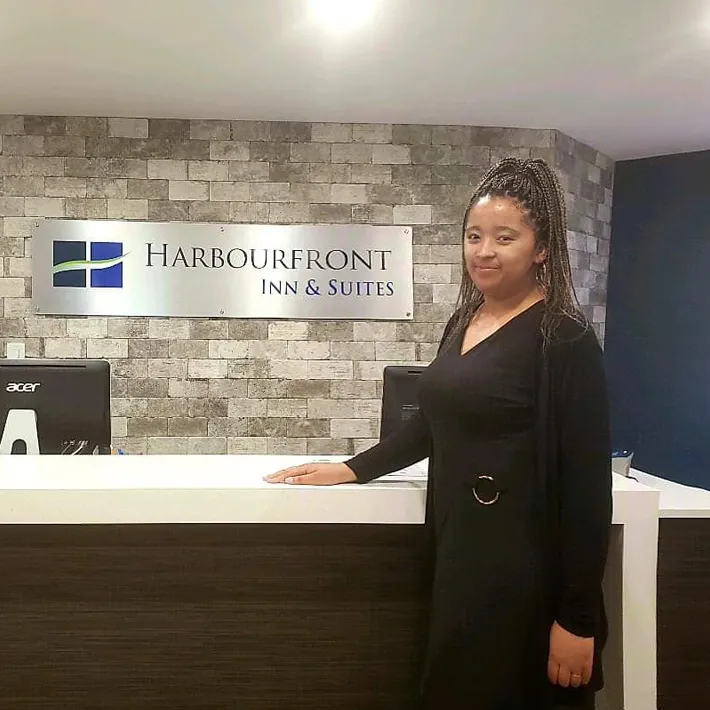
Tourism and hospitality industry professionals are in global demand. Some of the employers of our graduates include: Tourism Sarnia-Lambton, Fairmont Hotels & Resorts, Intercontinental Hotels & Resorts, Hyatt Hotels Corporation, Marriott Hotels & Resorts, Gateway Entertainment, and Spirit Ridge at Nkmip Resort. Graduates also find employment at Inns, Adventure Tourism, Food & Beverage companies, retail and entrepreneurial ventures.
Accreditations & Certifications
Nationally Recognized Certifications
Students in the Hospitality program will be given the opportunity to achieve these nationally recognized certifications:
- SmartServe Ontario
- TrainCan Food Safety Service
- American Hotel & Lodging Educational Institute (AHLEI) - Planning and Control for Food and Beverage Operations
- Workplace Hazardous Materials Information System (WHMIS 2015)
- Accessibility for Ontarians with Disabilities Act (AODA) Customer Service Standard Training
Co-op
More Information
Technology Requirements
It is recommended that you use a Windows laptop for your coursework. While other devices like MacBooks or Chromebooks might work for some tasks, they may not support all the software required for your program. If you're unsure, check with your professors before buying.
Internet Speed Requirements
To get the best experience while learning online, we recommend having an internet connection with at least 40 Mbps download speed and 10 Mbps upload speed. This will help you use video calls, attend online lectures, and access other learning tools smoothly.
Because students live in many different areas, we can't suggest a specific internet provider. You'll need to check with local companies to find one that works best for you.
Laptop Requirements
In order to access the internet and virtually-delivered software and courseware, student laptops should include the following at a minimum. By meeting the following specifications, students will be equipped to access software and courseware on their laptop through the internet:
- Intel i5 8th Gen Processor or equivalent
- 8GB of RAM
- 100 GB HDD or more
- Webcam with a microphone
- Wi-Fi capable (802.11n/ac 5GHz)
- Windows 11 operating system
Mobile Device
Students will require a mobile device (smartphone) for:
- Accessing your digital student ID
- Using campus applications and services
Software
To ensure students are getting the most our of their classroom experience, some software will be required.
Lambton College has made this software easily accessible online. Students can leverage our Microsoft Office 365 software packages and services. In addition, much of the software you require for your courses will be available on demand for use on any device - on or off campus.