
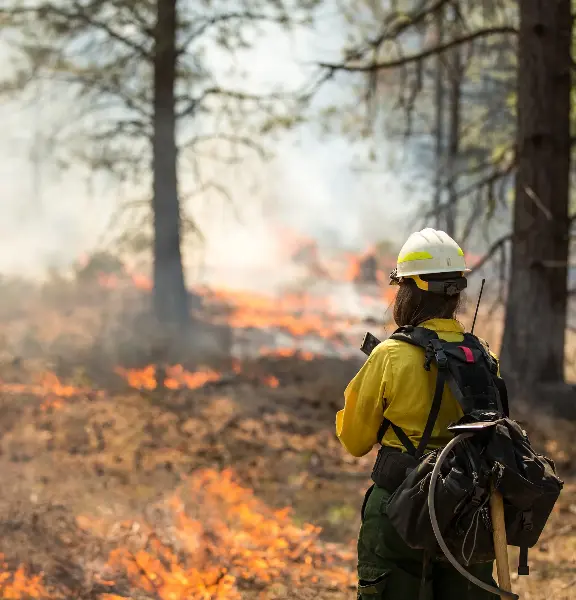
Wildfire Prevention & Emergency Response Operations
Overview
Prepare to protect communities from tomorrow's biggest emergencies. Gain advanced training in wildfire prevention, emergency response, disaster management, and leadership through Canada's first integrated wildfire and fire service diploma.
As climate change continues to increase the frequency and intensity of wildfires, floods, and other natural disasters across Canada, the need for highly trained emergency responders has never been greater. Communities require professionals who can prevent emergencies before they occur, respond effectively when they do, and lead coordinated recovery efforts in increasingly complex environments.
Lambton College's Wildfire Prevention & Emergency Response Operations advanced diploma prepares graduates to meet these evolving challenges. Building on the College's long-standing reputation for excellence in fire education, this innovative program expands beyond traditional firefighting to include wildfire prevention, emergency management, disaster response, public safety education, and incident leadership.
As the first program of its kind in Canada, this diploma brings together structural firefighting, wildland firefighting principles, emergency preparedness, and leadership development into one comprehensive educational experience. Students graduate prepared to contribute to municipal, provincial, industrial, and emergency response organizations while helping communities become more resilient in the face of natural disasters.
Take a look at our Fire Grounds
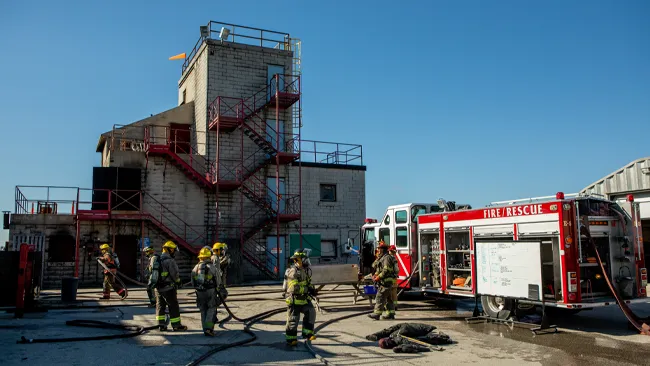
Located 14 km from the main campus and the largest live fueled training centre in Canada. Contact us to set up a tour of our one-of-a-kind facility.
Admission Requirements
- Pre-Service Firefighter Education & Training Certificate
-or-
Prior Learning Assessment with:
- NFPA 1001 Level I and Level II ProBoard or equivalent
- NFPA 1072 Awareness ProBoard or equivalent
- NFPA 1072 Operations ProBoard or equivalent
- Current York Physical Fitness or CPAT test or equivalent
-and-
O.S.S.D. or equivalent with:
- Grade 12 English C or U
- Grade 11 or 12 Mathematics C or U
- Grade 11 or 12 Chemistry C or U
Mature Student Assessment for this program is available in the subjects of English and Mathematics for the purpose of demonstrating proficiency in these required admission subjects. For all other admission requirements, applicants must complete the required course(s) as listed above. For more information, please contact counselling@lambtoncollege.ca. Review the Mature Student Admission process.
Academic admission requirements can be obtained through Academic Upgrading and the Pre-Programs at Lambton College.
Costs
- Fees will be determined in Spring 2027.
Pre-Service Firefighter Education & Training Students
If you already have some of the equipment listed from taking the Pre-Service Firefighter Education & Training program, you are not required to purchase again.
Technology Requirements
In order to keep pace with the requirements of each and every course in your program, Lambton College requires that each student have access to a laptop while studying at our college.
Labs & Equipment
Apparatus Bay
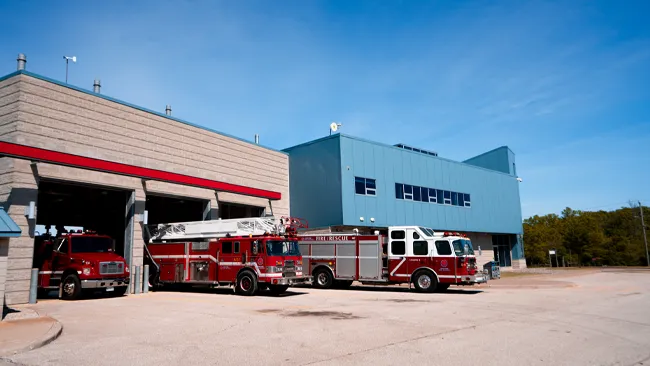
When you step into the Lambton College Fire School's apparatus bay, you find a fully functioning, state-of-the-art, Fire Station. Key features include: rapid air exchangers (to reduce CO2 and vehicle emissions), a sizable compressor room ensuring self-contained breathing apparatus (SCBA) are always on the ready, and a rope rescue wall. All of these features serve to enhance the real world training experience for our students. Three double bays house a fleet of fire apparatus including an aeriel, two engines, a tanker and rescue support vehicles (incident command, auto extrication and an ambulance.)
Fire School
The Lambton College Fire School, established in 1976, is the largest live-fueled fire training centre in Canada. Our suite of fire service programs provide graduates with the necessary skills and experience to become serious firefighter candidates. The team of expert instructors at the Fire School serve to solidify the college’s leadership position in delivering full fire service training by simulating scenarios using real-world props and ample time spent on the grounds, doing the work.
Courses
Fire & Life Safety Educator
This course is designed to provide students with the skills necessary to successfully achieve NFPA 1035. Certification in the following disciplines - Fire and Life Safety Educator Level I as well as Public Information Officer. Upon completion, students should be able to deliver and coordinate existing fire and life safety education at various levels within a community. In addition to looking at fire behaviour, human behaviour during fire, educational methodology, basic fire protection systems and devices, this course will also emphasize the planning and applied learning theories pertaining to fire and life safety education. As part of the Public Information Officer content, the course will emphasize effective writing skills as well as media dissemination and monitoring skills, through enhancement of interview skills and the development, maintenance, and strengthening of relationships with community group.
Fire Science Fitness III
The focus of this course is to help prepare students for the severe physical demands of Firefighting.
Critical Thinking & Writing
This writing course challenges students to explore diverse opinions and articulate their own perspectives clearly and persuasively. Through critical reading, students will develop skills in synthesis, analysis, comparison, and response, striving for clarity and diplomatic expression of their opinions based on factual evidence. Students will practice various rhetorical strategies of persuasion and hone their writing to ensure precision and accuracy in their messages. This course lays the foundation for a subsequent research-writing course, equipping students with essential skills for academic success.
Integrated Drone Technology for 1st Responders
This course examines the use of drone technology in emergency response, public safety, and disaster management environments. Students develop knowledge of Transport Canada regulations, airspace awareness, flight safety, mission planning, and operational drone deployment. Through practical flight exercises and realistic response scenarios, students learn how drones support search and rescue, scene assessment, hazard identification, and situational awareness. The course prepares students for the Transport Canada Basic Drone Operator Certification and provides foundational skills for applying drone technology in first responder and public safety settings.
Emergency Management
This course examines the relationship between hazards and disasters by exploring the historic and contemporary principles, policies, and legal frameworks guiding the field of practice. Analyze different paradigms for conceptualizing the practice of disaster and emergency management.
Hazards & Risk Assessment
This course examines the ongoing changing hazards of the 21st century and explores various approaches to disaster risk management used. The course consists of an in-depth exploration of hazard, vulnerability and resilience as well as analytic review of risk management frameworks that structure the assessment of hazards and their impacts on society.
Introduction to Wildfire Science
This course provides an overview of wildfire science, examining the physical and ecological factors that influence fire behaviour and the approach and practices used in forest fire management. Students explore fire dynamics, ignition sources, the Canadian Forest Fire Danger Rating System, and the interaction between weather, fuel, and topography. Commonly used wildfire fuel models, fire behaviour characteristics, and mitigation techniques are introduced and hazards associated and the impact to the built environment is also discussed. A strong focus is placed on the effects of climate change, including increasing wildfire frequency, severity, and duration. Through case studies and applied exercises, students will assess wildfire risks and analyze historical fire patterns. Canadian-related fire legislation will also reviewed.
Wildfire Suppression Techniques
This course provides practical training in wildfire suppression tactics, including containment, control, and mop-up operations. Students learn to assess fire behaviour in dynamic environments and apply suppression strategies using tools and equipment safely and effectively in varied terrain and conditions. Through embedded certifications in SP-100 Basic Fire Suppression and Safety, chainsaw operation, and restricted radio communication, students develop essential field competencies aligned with provincial standards. Emphasis is placed on teamwork, situational awareness, and safety protocols to prepare students for real-world wildfire response operations across diverse landscapes.
Fire Science Fitness IV
The course involves specialized assessment of health/performance fitness for potential firefighter recruits. The areas of emphasis will be: all components of fitness training, and lifestyle management for firefighters. In addition, students will practice job simulation/performance tests which simulate commonly encountered firefighting operations.
Communications for Fire Science
This course is designed to further develop students' communication proficiency, oral and written, which is required to be successful in the field of fire services, including the areas of prevention and education. Students will create workplace specific documents and research reports and will share their findings through oral presentations. Current fire services related issues will serve as the impetus for creating informed research reports and presentations.
Incident Management Systems & Operations
This course is designed to create an understanding of key foundational concepts as well as how to implement during simple and complex incidents, including the management and understanding of all divisions within the IMS. students will explore principles of command, coordination, communication, and operational control used across municipal, provincial, and national emergency response agencies. Students apply these concepts through scenario-based learning and case studies involving wildfire and all-hazard events. Successful completion of the course includes the embedded certifications for IMS 100 and IMS 200, equipping graduates with recognized credentials essential for participation in multi-agency emergency responses across Canada.
Leadership & Crew Resource Management
The course will prepare students in becoming leaders within their organizations. Students will look at various leadership styles and through the use of case studies, will understand which leadership styles are successfully implemented during time of crisis. Students will also examine the challenges of developing high preforming teams and explore tools and processes that can be implemented for operational success.
Applying GIS to Public Safety
During this course students will explore how GIS can be used to plan and mitigate potential hazards and threats while assisting with response and recovery efforts. Through case studies, students will explore how GIS has shaped and enhanced modern community risk reduction efforts as well as strategic plans for emergency services.
Emergency Exercise Design
Beginning with an overview of the basic concepts surrounding exercise design, this course prepares the student to design, conduct, control, evaluate and implement table-top emergency exercises.
Wildfire Mitigation Strategies
This course provides practical training in wildfire suppression tactics, including containment, control, and mop-up operations. Students learn to assess fire behavior in dynamic environments and apply suppression strategies using tools and equipment safely and effectively in varied terrain and conditions. Through embedded certifications in SP-100 Basic Fire Suppression and Safety, chainsaw operation, and restricted radio communication, students develop essential field competencies aligned with provincial standards. Emphasis is placed on teamwork, situational awareness, and safety protocols to prepare students for real-world wildfire response operations across diverse landscapes.
General Education Elective
Wildfire Preparation, Protection, & Implementation
This course prepares students to challenge the NFPA Certified Wildfire Mitigation Specialist (CWMS) exam by developing core competencies in wildfire science, hazard mitigation, risk reduction, and community preparedness. Students examine wildfire behaviour, landscape and structural vulnerabilities, community risk assessments, and defensible space design, with a strong emphasis on planning and public education to support communities. As part of the applied learning experience, students conduct Home Ignition Zone (HIZ) assessments using the NFPA CWMS Practicum Home Ignition Zone Assessment Form, applying best practices in real-world scenarios. Students obtain the technical knowledge and practical skills required to pursue the CWMS certification and lead wildfire mitigation efforts in urban, rural, and wildland-urban interface (WUI) environments.
Aeriel & Ground-based Firefighting Operations
In this course, students explore the integration of aerial and ground-based suppression tactics used in wildfire management. The roles, capabilities, and coordination of aircraft, ground crews, and equipment in both initial attack and sustained suppression efforts are also studied. Emphasis is placed on safety, communication, and tactical decision-making in dynamic wildfire environments. Students complete embedded certifications in SP-103 (Ground Ignition Operations) and Wildland Urban Interface (WUI) Training, preparing them to operate effectively in high-risk zones where wildland and urban areas intersect. The course also introduces the use of unmanned aerial systems (UAS), or drones, as a tool for real-time surveillance, hotspot detection, and operational planning.
Indigenous Knowledge & Wildfire Management
This course examines Indigenous fire stewardship practices and their role in landscape management, ecosystem health, and wildfire mitigation. Students learn about traditional burning techniques, cultural fire regimes, and Indigenous-led fire management initiatives. The course highlights the importance of collaboration between fire agencies and Indigenous communities, emphasizing respect for traditional ecological knowledge (TEK) and co-management approaches.
Evacuation & Reception Centre Planning & Operations
In this course, students learn the knowledge and skills to plan and coordinate effective evacuation strategies and reception centre operations during emergencies and disasters. Emphasis is placed on developing scalable evacuation plans, from neighbourhood-level incidents to mass evacuations that account for diverse community needs and social vulnerabilities, including mobility, language, housing insecurity, and health-related challenges. Students explore engagement practices, interoperability among emergency management partners, and the logistical and operational requirements necessary to establish and manage reception centres. Through case studies and applied planning exercises, students learn to assess site selection, staffing, resource allocation, and service delivery, ensuring that evacuation and reception centre plans are inclusive, coordinated, and responsive to real-world conditions.
Ethical Leadership & Decision Making
This course challenges students to critically examine the ethical dimensions of business decision-making. Students will explore the foundations of business ethics through philosophical and psychological theory. Students will develop clear definitions of stakeholders, morals, values, principles, and trust. Through the course activities, students will develop skills in ethical analysis and responsible decision-making. The course equips students with the tools to navigate complex dilemmas and to foster ethical practice in their professional and personal lives.
Capstone Project: Community Emergency Planning Operations
In this culminating course, students apply their knowledge and skills learned from previous program courses to develop a comprehensive emergency management plan. Working in teams, students conduct hazard assessments, propose mitigation measures, and outline emergency response strategies that align with national and provincial guidelines. The project integrates risk analysis, operational planning, and community engagement, providing students with practical experience in emergency preparedness and response coordination.
General Education Elective
Contact
School of Fire Science, Health & Community Services
Program Information
After Graduation
Employment Opportunities
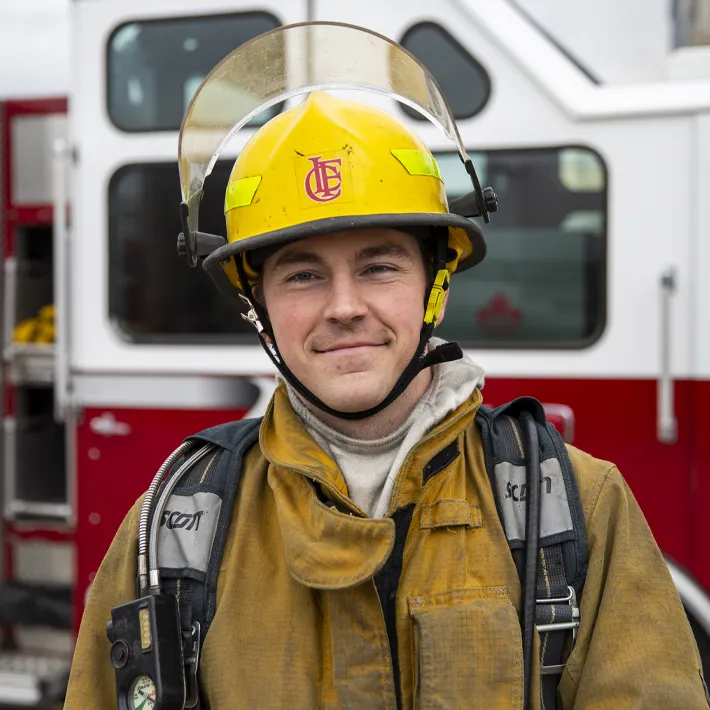
Graduates will be well-positioned for careers supporting emergency preparedness, wildfire prevention, disaster response, and fire protection across Canada.
Potential career pathways include:
- Wildland Firefighter*
- Emergency Management Coordinator
- Emergency Preparedness Officer
- Community Emergency Management Assistant
- Fire Prevention Officer
- Fire and Life Safety Educator
- Emergency Operations Centre Support
- Industrial Emergency Response Team Member
- Municipal Emergency Services
- Disaster Recovery and Resilience Planning
- Public Safety and Risk Management
*Additional agency-specific hiring requirements, fitness standards, and certifications may apply.
The broad skillset developed through this program also complements careers within municipal fire services, industrial emergency response, public safety organizations, conservation authorities, Indigenous communities, government agencies, and non-government emergency response organizations.
More Information
Build Career Ready Skills
As part of their capstone project, students will develop a comprehensive emergency management plan for an organization. This hands-on experience helps students apply their skills, solve real-world challenges, and build a portfolio piece to share with future employers.

Skill Demands
All students are required to meet the following demands:
- Applicants must be able to lift a bulk mass of 18 kg (40 lbs) and have the ability to dismantle and assemble large pieces of equipment.
- A satisfactory level of both fine and gross motor control.
- Must climb vertical ladders and walk on platforms with open gratings.
- Will not be allowed to wear glasses when wearing breathing apparatus.
- Must be clean shaven to ensure a good seal with the face mask.
- Must possess at minimum a G2 license by the end of the fall semester.
The following are not requirements of the program, but students should be aware that these requirements must be met if you are hoping to pursue a career with the municipal fire service:
- Visual requirements of 20/30 in each eye, without the use of contact lenses, and satisfactory completion of a colour vision assessment may be required.
- Should not be convicted of a criminal offense for which a pardon has not been granted.
- Should be able to communicate in English, both written and orally.
Some students with disabilities may require academic accommodation to equalize opportunities to meet the academic demands of a course or program.
Technology Requirements
It is recommended that you use a Windows laptop for your coursework. While other devices like MacBooks or Chromebooks might work for some tasks, they may not support all the software required for your program. If you're unsure, check with your professors before buying.
Internet Speed Requirements
To get the best experience while learning online, we recommend having an internet connection with at least 40 Mbps download speed and 10 Mbps upload speed. This will help you use video calls, attend online lectures, and access other learning tools smoothly.
Because students live in many different areas, we can't suggest a specific internet provider. You'll need to check with local companies to find one that works best for you.
Laptop Requirements
In order to access the internet and virtually-delivered software and courseware, student laptops should include the following at a minimum. By meeting the following specifications, students will be equipped to access software and courseware on their laptop through the internet:
- Intel i5 8th Gen Processor or equivalent
- 8GB of RAM
- 100 GB HDD or more
- Webcam with a microphone
- Wi-Fi capable (802.11n/ac 5GHz)
- Windows 11 operating system
Mobile Device
Students will require a mobile device (smartphone) for:
- Accessing your digital student ID
- Using campus applications and services
Software
To ensure students are getting the most our of their classroom experience, some software will be required.
Lambton College has made this software easily accessible online. Students can leverage our Microsoft Office 365 software packages and services. In addition, much of the software you require for your courses will be available on demand for use on any device - on or off campus.