

Pre-Health Sciences Pathway to Advanced Diplomas & Degrees
Overview
Academically prepare yourself for nursing and other health science programs while gaining a competitive edge for admission into these highly competitive fields.
The Pre‑Health Sciences Pathway to Advanced Diplomas & Degrees is a one‑year certificate that helps you build the academic foundation needed for all health science diploma and degree programs, including nursing. It is a good option if you do not yet meet admission requirements or want to improve your grades for competitive programs.
You will build skills in biology, chemistry, math, and communication, while developing the study habits and confidence needed for college-level learning. You will also explore different health career paths and gain a better understanding of what to expect in future studies.
This program is a strong starting point if you want to apply to programs such as nursing, paramedic, or other health science fields.
Completing this program does not guarantee admission to another program. Health programs are competitive, and admission is based on your grades and program-specific requirements.
This program is a good fit if you:
- want to pursue a career in health care
- need to strengthen your academic background
- are looking for a clear pathway into future study
- want support transitioning into college
Admission Requirements
- O.S.S.D. or equivalent
Highly Competitive Program
This is a highly competitive program and students are encouraged to apply by February 1 - the equal consideration deadline.
Costs
- Year 1 $4,250.34
Please note: These fees apply to the 2026-2027 academic year and are subject to change. Fees do not include books (unless specifically noted), supplies or living costs.
Additional Fees
-
Textbooks - Term 1$900.00
-
Textbooks - Term 2$150.00
-
Supplies$200.00
Technology Requirements
In order to keep pace with the requirements of each and every course in your program, Lambton College requires that each student have access to a laptop while studying at our college.
Labs & Equipment
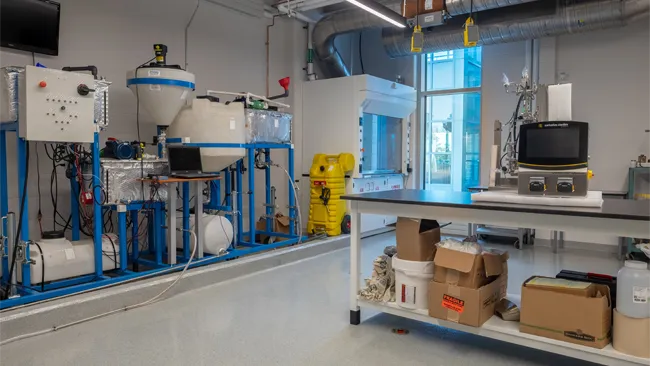
Biology Lab
Laboratory exercises complement theoretical concepts and develop good, safe, laboratory practices, as well as competency in laboratory techniques, through hands-on lab procedures and experimentation.
Courses
Medical Terminology
Develop the language required to communicate effectively in a medical setting. Medical terminology, word structure as well as diagnostic procedures and pharmacology related to twelve body systems will be studied.
Critical Thinking & Writing
This writing course challenges students to explore diverse opinions and articulate their own perspectives clearly and persuasively. Through critical reading, students will develop skills in synthesis, analysis, comparison, and response, striving for clarity and diplomatic expression of their opinions based on factual evidence. Students will practice various rhetorical strategies of persuasion and hone their writing to ensure precision and accuracy in their messages. This course lays the foundation for a subsequent research-writing course, equipping students with essential skills for academic success.
Math for Health Sciences I
This course is designed to prepare learners to apply math concepts in health care settings. Learners will develop essential critical thinking and problem-solving skills through exposure to application problems, including dosage calculations, IV calculations, and mixtures. The course helps learners build a solid foundation in arithmetic, algebra, and geometry. Other topics include percentages, ratios and proportions, dimensional analysis, manipulating formulas, solving equations, and graphing linear functions.
General Chemistry I
Cell Physiology
This course in cell physiology includes the core topics of the characteristics of life, microscopy, applied chemistry and biochemistry, cell structure and function, cellular respiration, molecular biology of the gene, Mendelian genetics, DNA replication and protein synthesis. Laboratory exercises are performed in order to emphasize and apply the topics discussed in class.
Introduction to Health Care
In our increasingly complex world there is a growing awareness that health care delivery is in a crisis situation. In order to make the best decisions, health care professionals must be aware of how our health care system works, where it has come from, the future of health care, and where health professionals fit within the bigger picture. This course is designed to introduce the student to these concepts by examining the interrelationships between the individual, community and international health care. Also covered in this course is, the role stress plays in health, alternative and complementary health care, as well as personal and professional ethics, attitudes, and values.
Introduction to Cultural Anthropology
Employing the anthropological perspective this course examines culture and culture "life ways" through the lens of engaged interdependence, global socio-economic sustainability, and inclusion. Cross-cultural comparison, the nature of world order, decolonization, and the construction of identify and gender through culture are core themes running throughout ANT 200's learning outcomes and applied learning assignments (ALA). Each of the five units includes opportunities to apply learning through small group dialogue, gamification, and personal reflection, with the goal of building greater self-awareness as part of a wider interdependent community.
Communications for Health
This course, designed for students in the health field, further develops students' communication proficiency. Students create workplace documents and research reports and share their findings through oral presentations. Advocacy and peer education will drive the research and documentation process. Current health issues and research will serve as the impetus for creation of informed research reports and presentations.
Mathematics for Health Sciences II
This course is a continuation of MTH-1623 and is designed to further algebra skills and introduce statistical processes. Learners will develop essential critical thinking and problem-solving skills through exposure to application problems, including isotope half-life, pH, and statistics relating to the health-care field. This course covers algebraic topics such as systems of linear equations, exponential equations, and logarithmic equations. Statistical concepts include descriptive statistics, basic probability, regression analysis, binomial and normal distributions, and confidence intervals.
General Chemistry II
Introduction to Biology
This course is designed to introduce the student to basic human anatomy and physiology through the study of organ systems including the following: nervous, circulatory, respiratory, digestive and urinary. General organization of the body, cells, tissues, and organs will also be considered.
General Education for Diploma Programs/Elective for Degree Programs
Contact
Faculty of Nursing and Health Sciences
Program Information
After Graduation
Pathway Opportunities

Graduates can apply to health sciences programs at Lambton College and other Ontario colleges if they meet the admission requirements for their chosen program.
This certificate can help you meet minimum graduation and admission requirements, but entry into health programs is competitive and often requires higher averages plus any additional program-specific requirements.
If you plan to continue into a health science program:
- review the admission requirements for your chosen program
- aim for strong grades throughout this program
- be aware that some programs may have additional requirements
Health Science programs you may choose to apply to include:
Pathways
Build on your education and complete a college diploma or university degree in Ontario, Canada, or abroad
Want to see more Ontario transfers? Visit ONTransfer.ca.
More Information
Skill Demands
Health Science related programs are very vigorous programs with respect to academic and skill demands. Some students with disabilities may require academic accommodation to equalize opportunities to meet the academic demands of a course or a program.
Technology Requirements
Internet Speed Requirements
For the best online learning experience, we recommend an internet connection with at least 40 Mbps download speed and 10 Mbps upload speed. This will help you attend online classes, join video calls and access online learning tools.
Internet service varies by location, so you will need to choose a provider that is available in your area.
Laptop Requirements
You will need a laptop to access online course materials, software and other learning tools. Your laptop should meet these minimum requirements:
- Intel i5 8th Gen Processor or equivalent
- 8GB of RAM
- 100 GB HDD or more
- Webcam and microphone
- Wi-Fi capable (802.11n/ac 5GHz)
- Windows 11 operating system
Mobile Device
You will also need a smartphone to:
- Access your digital student ID
- Use campus applications and services
Software
Some courses require specific software. Lambton College provides access to Microsoft 365 and other software needed for your studies. Much of your course software is available online and can be accessed on or off campus.